Joints and Bridges in graphs
📌 Table of Contents
1. DFS tree
//DFS tree
int h[maxn],in[maxn],out[maxn],low[maxn];

void DFS(int u, int v)
{
    ++ti;
    in[u]=ti;
    low[u]=ti;
    for(int i:adj[u])
    {
        if(i==v)    continue;
        if(!in[i])
        {
            DFS(i,u);
            low[u]=min(low[u],low[i]);
        }
        else    low[u]=min(low[u],in[i]);
    }
    out[u]=ti;
}
-
Basically,
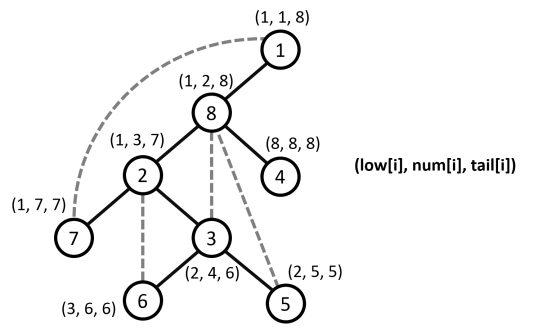
inandoutarrays will be calculated as in a normal Euler tour. The rest will be an array that helps us identify whether a vertex is a joint or an edge is a bridge.
2. What is a bridge?
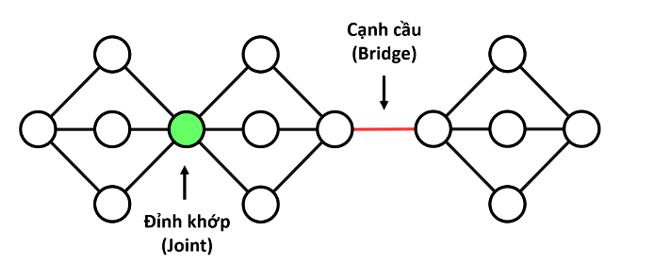
Explanation: A bridge is an edge that, when removed it, increases the number of connected components in the graph.
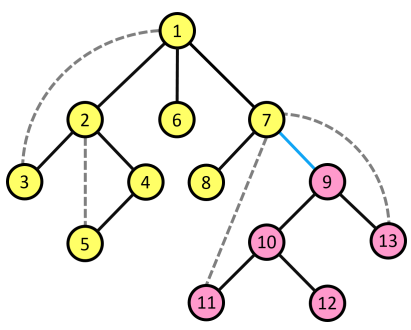
- If the edge to be removed is a dashed edge, it is definitely not a bridge.
- Suppose we want to remove edge (7,9). If the subtree of 9 has a dashed line going upwards, then (7,9) is not a bridge edge, and vice versa.
→ Therefore, to check if an edge (u,v) is a bridge, simply check if low(u) = in(u). If so, it is a bridge edge.
3. What is a joint?
Explanation: A joint is a vertex that, when removed along with its incident edges, increases the number of connected components in the graph.
We will divide into 2 cases:
- If the vertex being examined is the root of the DFS tree, and the root has two or more direct children, then the root is a match.
-
If the vertex under consideration is not the root of the DFS tree (removing vertex
u, wherevis a direct child of u in the DFS tree). If there exists a vertexvsuch thatlow(v) ≥ num(u), thenuis a joint.
→ With this checking method, we can determine whether a vertex is a joint directly during the DFS process.
bool mark [maxn];
// mark[u] = true means that u is a joint
void DFS(int u, int v)
{
  int cnt=0;
  ++ti;
  in[u]=low[u]=ti;
  for(int i:adj[u])
  {
  if(i==v)    continue;
  if(!in[i])
    {
      ++cnt;
      DFS(i,u);
      low[u]=min(low[u],low[i]);
      if(v==0 && cnt>1)   mark[u]=true;
      else if(low[i]>=in[u]) mark[u]=true;
    }
    else    low[u]=min(low[u],in[i]);
  }
  out[u]=ti;
}
4. Strongly Connected Components (Tarjan's algorigthm)
//SCC - Tarjan's algorithm
void DFS(int u)
{
  in[u] = low[u] = ++ti;
  f.push(u);
  for(int i:adj[u])
  {
    if(deleted[i])  continue;
    if(in[i])   low[u] = min(low[u],in[i]);
    else
    {
      DFS(i);
      low[u] = min(low[u],low[i]);
    }
  }
  if(low[u] == in[u])
  {
    scc++;
    int v;
    do {
      v = f.top();
      f.pop();
      id[v] = scc;
      deleted[v] = true;
    }
    while (v != u);
  }
}

void input()
{
  cin>>n>>m;
  for(int i=1,u,v;i<=m;++i)
  {
    cin>>u>>v;
    adj[u].pp(v);
  }
  for(int i=1;i<=n;++i)
    if(!in[i])  DFS(i);
  cout<<scc;
}