Convex Hull Trick for Line Queries
📌 Table of Contents
1. Problem
Given a set of linear functions in the form f(x) = ax + b and a series of query points x, determine the maximum or minimum value of f(x) for each query.
- Solution: Use the Convex Hull Trick algorithm to efficiently solve this problem. This algorithm selects lines such that they form a convex hull, thereby optimizing the search for max/min values.
-
The complexity of all add operations is
O(n)since there arenlines and onlynlines can be added or removed. -
The complexity of each get operation is
O(log n)due to the use of binary search.
2. Create the CHT structure
// Convex Hull Trick structure
struct CHT
{
  int n,a[maxn],b[maxn];
  vector <int> line;
  vector <ld> point;
  CHT()
  {
	//constructor
    point.pp(-1e18);
  }

  ld intersect (int x, int y)
  {
    //calculate intersect of 2 lines
    return (ld)1.0 * (b[x]-b[y])/(a[y]-a[x]);
  }
}
3. Build function
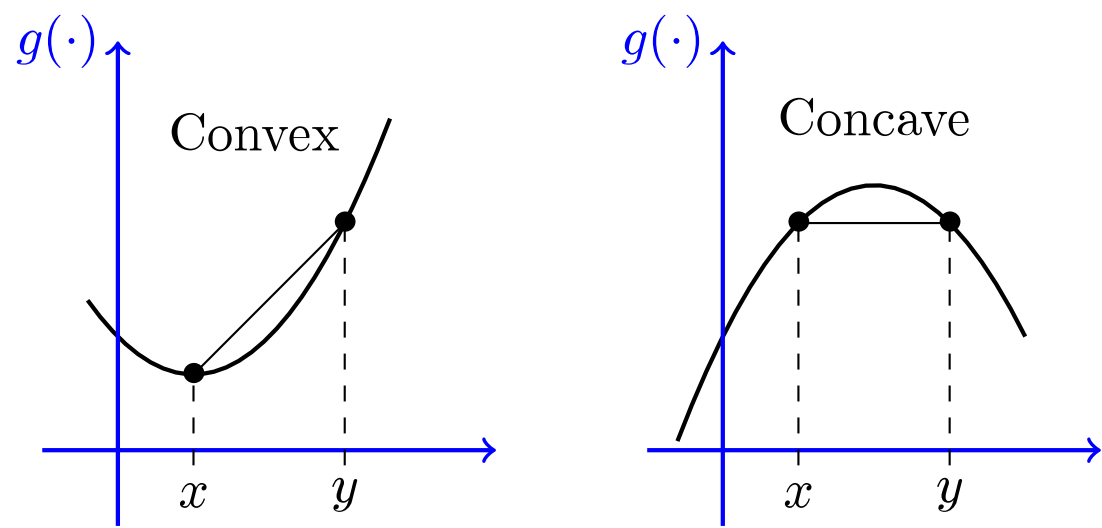
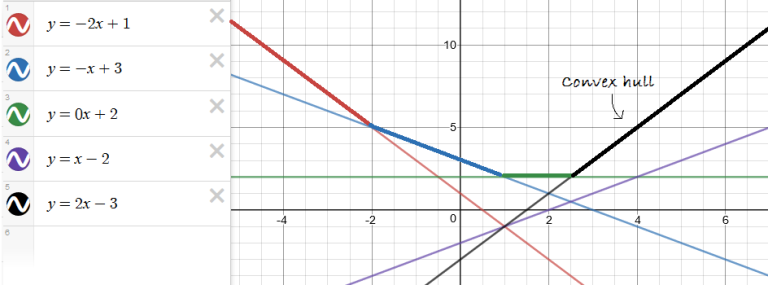
For the maximum-value problem, sort the lines by their slope in ascending order. This ensures that the maximum values of ax + b at any x will lie on the upper convex hull.
(For the minimum-value problem, simply sort in descending order instead.)
void build()
{
  vector <int> id;
  for(int i=1;i<=n;++i)   id.pp(i);
  sort(all(id),[&](const int& x, const int& y){
    return a[x]<a[y];});
  for(int i:id)   add(i);
}
4. Add function
Case 1: Slope coefficients are equal a → Remove edges based on b
Case 2: Slope coefficients are different a (applies to both types of Convex Hull)
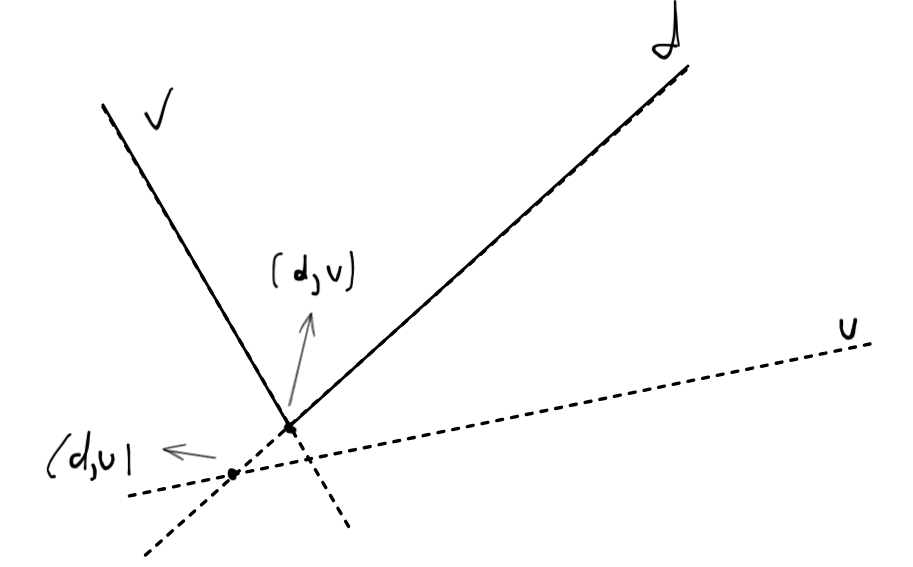
- Let the line to be added be d, the last line in the Convex Hull be u, and the line before u be v
- If the x-coordinate of the intersection point of (d, u) is less than (d, v) → Remove line u
- Add line d to the Convex Hull
void add(int i)
{
  while(line.size()>0)
  {
    if(a[line.back()]==a[i])
    {
      if(b[line.back()]>=b[i])    break;
      else
      {
        line.pop_back();
        if(line.size()>0)   point.pop_back();
      }
    }
    else
    {
      if(line.size()<2)   break;
      if(intersect(i,line.back())<intersect(i,line[line.size()-2]))
      {
        line.pop_back();
        if(line.size()>0)   point.pop_back();
      }
      else    break;
    }
  }
  if(line.size()==0 or a[line.back()]!=a[i])
  {
      if(line.size()>0)   point.pp(intersect(line.back(),i));
      line.pp(i);
  }
}
5. Get function
When we have x , the remaining task is to perform binary search on the point vector and print the result
ll gt(ll x)
{
  int id=upper_bound(all(point),x)-point.begin()-1;
  return a[line[id]]*x+b[line[id]];
}
6. Template
#include <bits/stdc++.h>
#define ff first
#define ss second
#define pp push_back
#define all(x) (x).begin(),(x).end()
using namespace std;
using ll = long long;
using ld = long double;
using pii = pair <int,int>;
using pll = pair <ll,ll>;
using pld = pair <ld,ld>;
const char el ='\n';
const char sp = ' ';
const int maxn = 2e5+5, mod = 1e9+7;

struct CHT
{
  int n,a[maxn],b[maxn];
  vector <int> line;
  vector <ld> point;

  CHT(){
    point.pp(-1e18);}

    ld intersect (int x, int y){
      return (ld)1.0 * (b[x]-b[y])/(a[y]-a[x]);}

    void add(int i)
    {
      while(line.size()>0)
      {
        if(a[line.back()]==a[i])
        {
          if(b[line.back()]>=b[i])    break;
          else
          {
            line.pop_back();
            if(line.size()>0)   point.pop_back();
          }
        }
        else
        {
          if(line.size()<2)   break;
          if(intersect(i,line.back())<intersect(i,line[line.size()-2]))
          {
            line.pop_back();
            if(line.size()>0)   point.pop_back();
          }
          else    break;
          }
        }
        if(line.size()==0 or a[line.back()]!=a[i])
        {
            if(line.size()>0)   point.pp(intersect(line.back(),i));
            line.pp(i);
        }
    }

    void build()
    {
      vector <int> id;
      for(int i=1;i<=n;++i)   id.pp(i);
      sort(all(id),[&](const int& x, const int& y){
        return a[x]<a[y];});
      for(int i:id)   add(i);
    }

    ll gt(ll x)
    {
      int id=upper_bound(all(point),x)-point.begin()-1;
      return a[line[id]]*x+b[line[id]];
    }

};
CHT f;


void input()
{
  cin>>f.n;
  for(int i=1;i<=f.n;++i)   cin>>f.a[i]>>f.b[i];
  f.build();
  int m;
  cin>>m;
  while(m-->0)
  {
    ll x;
    cin>>x;
    cout<<f.gt(x)<<el;
  }
}

int main()
{
  ios_base::sync_with_stdio(false);
  cin.tie(nullptr);
  input();
  return 0;
}